The short, qualified explanation
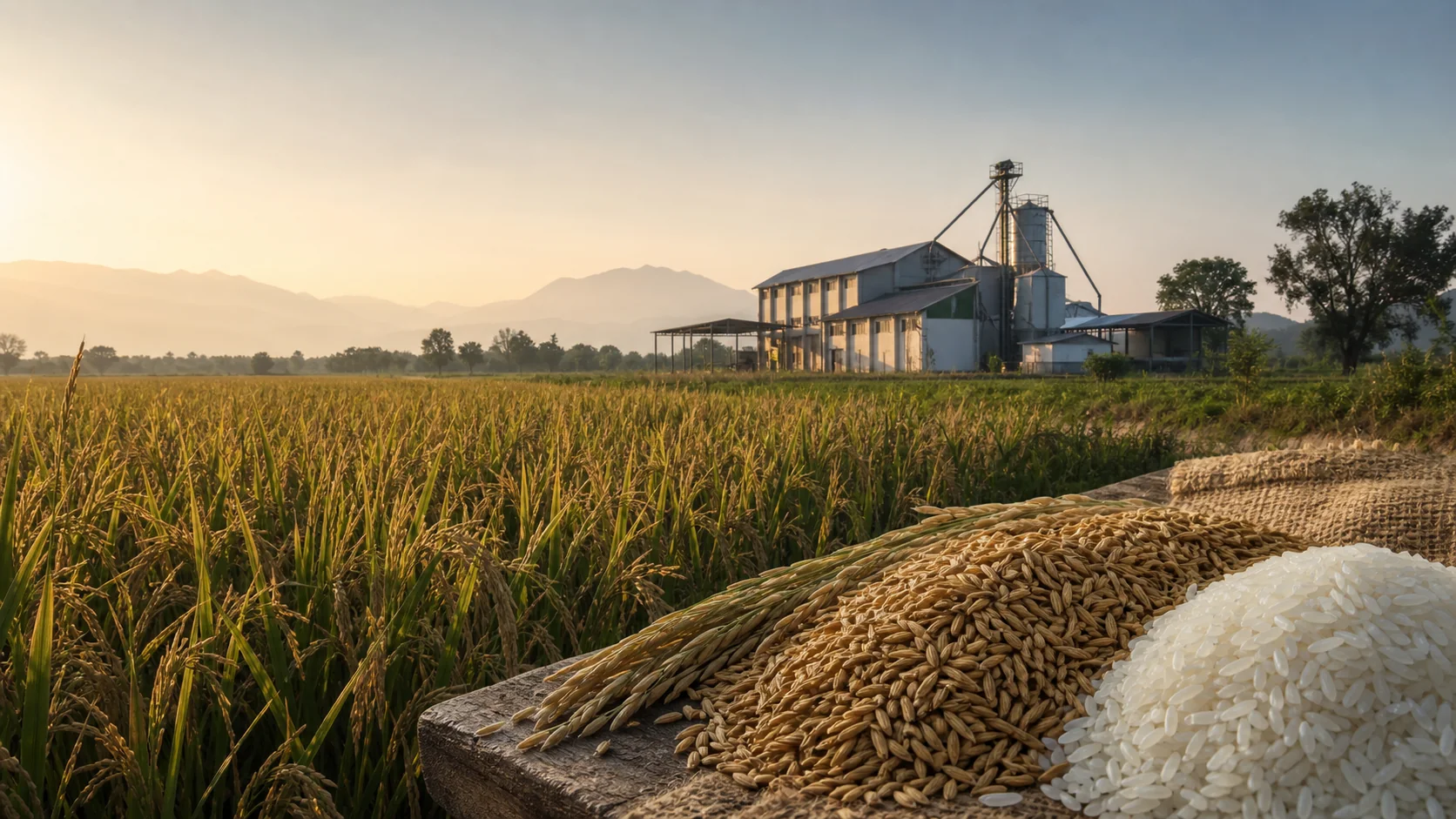
Rice milling removes the husk from cleaned paddy and, depending on the intended output, removes some or all of the bran layers. Commercial systems may then separate unhulled paddy, whole or near-whole kernels, broken kernels, bran, and husk. The equipment and sequence vary between mills, so this general pathway is not a claim about the machinery or exact process used at Sudha Rice & Seeds.
Paddy is the starting material
Paddy is harvested rice with its outer husk still attached. Before husking, commercial milling guidance commonly places attention on receiving, pre-cleaning, and the condition of the incoming paddy. Pre-cleaning is intended to remove material that should not enter later stages and to make the flow more consistent.
The condition of paddy can affect how it behaves during processing, but an educational overview cannot establish the quality of a particular lot. Moisture assessment, intake criteria, sampling, and acceptance rules are operational matters that must be confirmed by the mill responsible for that lot.
- Paddy identity and condition should be recorded before specific claims are made.
- Foreign-material removal is different from grading the finished rice.
- A generic process diagram is not evidence that every listed step is performed at a particular mill.
Husking separates the outer covering
Husking removes the protective outer husk. The flow leaving this stage can contain brown rice, husk, and paddy that was not fully husked. Commercial systems may use separation and recirculation so unhulled paddy can be handled again rather than being represented as finished rice.
Husk is a distinct output from this stage. It is not the same as rice bran. Bran is associated with the layers around the grain that are removed later when brown rice is whitened. Keeping those terms separate matters when discussing handling, sale, or specialist downstream use.
Whitening, polishing, sifting, and grading are separate ideas
Whitening removes bran layers from brown rice to produce milled white rice. Polishing, where used, is a further surface-finishing step; it should not be treated as a synonym for every part of milling. Sifting and length grading can then separate material by the configured commercial specification.
Whole or near-whole kernels and broken kernels can emerge as separate fractions. Their exact classification depends on the applicable specification and agreed trade description. A local name by itself does not establish grain length, broken percentage, processing method, or intended use.
- Husk comes from removing the outer covering.
- Bran comes from removing layers around brown rice during whitening.
- Broken kernels are separated rice fragments, not another crop.
- Finished categories require an agreed specification, not only a familiar market label.
A responsible mill description distinguishes the typical from the verified
An accurate business website should show only the stages the operator confirms are actually performed. It should avoid turning a typical commercial flow into an unsupported claim about automated sorting, laboratory testing, extraction, capacity, or output quality.
The useful questions are practical: which stages are carried out, which equipment is in service, what is inspected, how outputs are separated, how lots are identified, and which details can be confirmed for the current requirement. Those answers belong in owner-approved operational content.
Editorial record
- Prepared by
- Sudha Rice & Seeds Editorial Team
- Sources checked
- 26 July 2026
- Review status
- Business and operational review pending
The named editorial team describes content ownership, not a professional credential or independent certification. No reviewer is named while operational review remains pending.
Practical qualifications
- A mill may combine, omit, or reorder stages according to its equipment, paddy condition, and intended output.
- Routine visual or process checks must not be described as laboratory testing without documented evidence.
- No machinery, automation, capacity, yield, certification, or production claim is made for Sudha Rice & Seeds in this article.
- Actual product specifications and availability must be confirmed directly with the mill.
Sources checked for this article
These links support the general concepts stated above. They do not verify the equipment, process, products, or downstream operations of Sudha Rice & Seeds.
- International Rice Research Institute: Milling and processing
General milling stages, the distinction between husk, bran, milled rice and broken kernels, and the fact that mill configurations vary.
official guidance · Accessed 26 July 2026 - International Rice Research Institute: Commercial rice milling systems
Typical commercial operations such as pre-cleaning, husking, whitening, polishing, sifting and length grading.
official guidance · Accessed 26 July 2026 - International Rice Research Institute: Rice by-products
Where rice husk and rice bran arise in the milling sequence.
official guidance · Accessed 26 July 2026
Continue with the mill's canonical information.
Use these pages for the site's current business context and contact route. Availability and specifications still require direct confirmation.