Rice Types, Milling Outputs and Their Uses
Rice milling produces more than finished whole rice. Depending on the paddy variety, processing method, equipment, moisture condition and grading system, a mill may separate whole rice, different sizes of broken rice, rice bran and paddy husk.
These outputs can serve food-processing, feed, energy, agricultural and industrial applications when they meet the relevant buyer specification and regulatory requirements. This page separates general industry information from facts about the current operation and availability at Sudha Rice & Seeds.
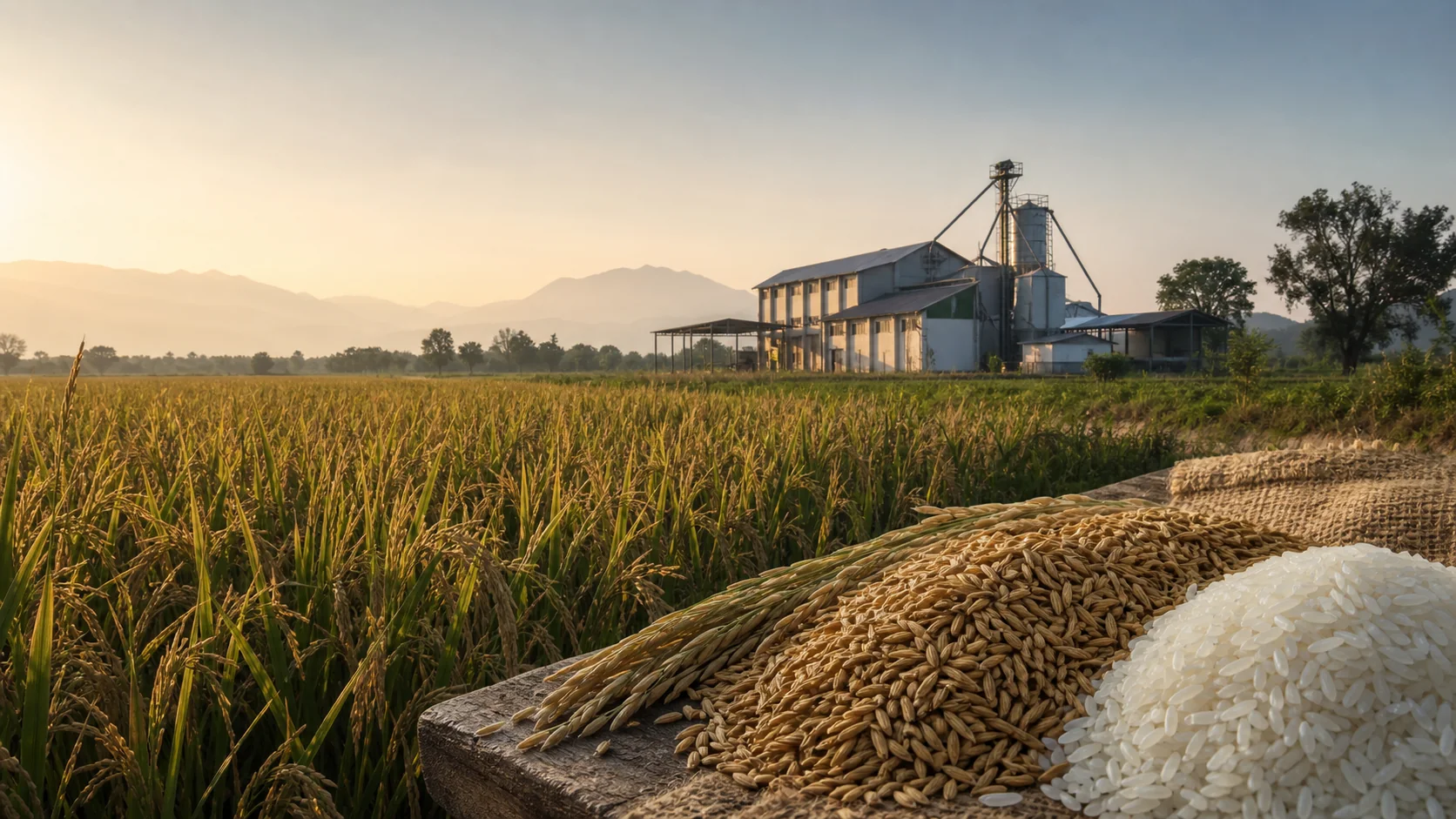
What does “type of rice” mean?
The same phrase can describe an agricultural variety, a processing form or a milling grade. Keeping those ideas separate makes specifications clearer.
Classification by paddy variety
Rice may be described by its agricultural variety and grain characteristics. These names explain the grain or variety; they do not tell a buyer how the paddy was processed or how much of the milled lot consists of whole and broken kernels.
- Basmati rice
- Non-basmati rice
- Long-grain rice
- Medium-grain rice
- Short-grain rice
- Aromatic rice
- Non-aromatic rice
These are general examples. This page does not claim that Sudha Rice & Seeds currently produces or supplies every category.
Sources: [1]
Classification by processing method
Processing form describes what happens to paddy or husked rice before and during milling. A single agricultural variety may be prepared as raw, steam or parboiled rice when the mill process and buyer requirement support that form.
- Raw rice
- Steam rice
- Parboiled rice
- Brown rice
- White or milled rice
Processing form is different from agricultural variety. Steam rice and parboiled rice should not be treated as automatically identical.
Classification by milling grade
After milling, rice can also be separated according to the proportion and size of whole and broken kernels. Formal assessment commonly distinguishes head rice, larger and smaller brokens, longitudinal brokens and fragments using measurable criteria.
- Head rice or whole rice
- Large broken rice
- Medium broken rice
- Small broken rice
- Fine rice fragments
- Rice tips or corner fragments
Local names such as Dwar, Tiwar, Khanda and Nakku must not be assumed to map exactly to a formal category without a confirmed specification.
How paddy may separate into different outputs
This is an educational flow, not a claim that every machine, stage or output is part of the current Sudha Rice & Seeds operation.
- 01
Paddy
The starting agricultural grain. Variety, grain condition and the intended processing route affect the later milling result.
- 02
Cleaning and removal of foreign material
A typical mill removes material that should not enter the husking and milling stages. The equipment and number of passes vary by system.
- 03
Husking
Husking removes the protective outer covering. A configured separation system may then distinguish brown rice from paddy husk and any unhusked paddy.
- Brown rice
- Paddy husk
- 04
Whitening or polishing
Whitening or polishing removes part or most of the bran layer from brown rice according to the intended milling degree.
- White or milled rice
- Rice bran and polish
- 05
Rice grading
Grading can separate whole kernels and different broken-rice fractions. The names, number of fractions and cut points depend on the grader and approved commercial specification.
- Head rice or whole rice
- Dwar
- Tiwar
- Khanda
- Nakku
- Other owner-approved rice fractions
Main rice types explained without availability assumptions
These are informational definitions. A listed form is not automatically a product currently made or supplied by Sudha Rice & Seeds.
Raw rice
Raw rice is produced by milling dried paddy without completing a parboiling process before milling. Its colour, cooking behaviour, texture and grain characteristics depend on the paddy variety, grain condition and degree of milling.
Possible applications
- Household cooking
- Restaurants and institutional kitchens
- Rice flour manufacturing
- Food processing
- Trading and wholesale supply
Availability and the actual product specification must be confirmed through WhatsApp.
Ask About Raw rice on WhatsAppSteam rice
Steam rice is a market term generally used for rice processed with controlled steaming before or during a broader processing sequence. The precise treatment can differ between mills, rice varieties and buyer specifications.
Possible applications
- Household consumption
- Restaurants and catering
- Food-service businesses
- Wholesale rice trade
Steam rice is not presented as automatically identical to parboiled rice, and it is not represented as a current Sudha output until management confirms it.
Sources: [4]
Ask About Steam rice on WhatsAppParboiled rice
Parboiled rice is produced by subjecting paddy to hydrothermal processing, normally involving soaking, heating or steaming and drying before milling. The exact process controls the resulting grain characteristics.
Possible applications
- Household cooking
- Institutional food supply
- Restaurants and food service
- Rice trading
- Further food processing
No medical, diabetes, weight-loss, glycaemic or nutritional-superiority claim is made.
Ask About Parboiled rice on WhatsAppBrown rice
Brown rice is produced after the outer husk is removed while most of the bran layer remains around the grain. It is a processing form, not a statement about a specific variety.
Possible applications
- Household cooking
- Food-service use
- Specialist food processing
This page does not state that Sudha Rice & Seeds currently supplies brown rice. Nutritional comparisons require separate verified evidence and review.
Ask About Brown rice on WhatsAppWhite or milled rice
White or milled rice is obtained after the husk and part or most of the bran layer have been removed through milling and polishing. Milling degree and grain appearance depend on the process and specification.
Possible applications
- Household and institutional cooking
- Food-service operations
- Food processing
- Rice trade
Exact milling degree, variety, whole-kernel content and lot condition must come from the current specification.
Ask About White or milled rice on WhatsAppHead rice or whole rice
Head rice refers to whole or nearly whole milled kernels retained after milling and grading. Formal standards use measurable kernel-length criteria, while a commercial lot may follow an agreed buyer specification.
Possible applications
- Household cooking
- Restaurants and food service
- Institutional supply
- Rice trading
Head rice is not described as 100% unbroken unless a verified lot specification supports that exact statement.
Ask About Head rice or whole rice on WhatsAppUnderstanding Broken Rice
Broken rice consists of sound rice kernels that break into smaller pieces during milling, handling or grading. It is not automatically waste. Depending on its measured size, cleanliness, grade and intended use, it may support food, feed or industrial processing.
What products can be made from broken rice?
- Rice flour, noodles, rice cakes and snack processing
- Breakfast cereal and institutional food processing
- Starch and fermentation-based processing
- Professionally formulated feed, only for a suitable and approved grade
Dwar, Tiwar, Khanda and Nakku
These names are retained exactly as used by Sudha Rice & Seeds. They are not converted into a national grade or assigned an invented size.
Dwar
A Local Broken Rice Grade
What is Dwar?
Dwar is a local rice-trade term for a separated broken-rice fraction. It can describe a commercially graded output, but the exact kernel size, composition and specification depend on the rice variety, grading equipment, mill settings, local market practice and the buyer’s agreed requirements.
Possible uses, subject to grade
- Rice flour and traditional rice-based foods
- Snacks, breakfast cereals, noodles and rice cakes
- Starch and fermentation-based processing
- Institutional food processing
- Feed manufacturing, only when the actual grade is suitable and approved
No grain length, sieve size, percentage, quantity, certification or grade is published for Dwar without a confirmed record.
- Rice variety
- Processing type
- Approximate fraction size
- Moisture
- Broken percentage
- Purity
- Intended use and grade
- Available quantity
- Current availability
Formal grading context: [4]
Ask About Dwar on WhatsAppTiwar
A Local Broken Rice Fraction
What is Tiwar?
Tiwar is a local trade name for a particular graded rice fraction. It may represent a selected size of broken rice, but its exact composition and cut point are specific to the mill’s grading system, rice variety and the buyer’s commercial specification.
Possible uses, subject to grade
- Rice flour and processed rice foods
- Snacks, noodles and cereal products
- Institutional cooking
- Starch and fermentation-based processing
- Approved feed applications
No grain length, sieve size, percentage, quantity, certification or grade is published for Tiwar without a confirmed record.
- Rice variety
- Processing type
- Approximate fraction size
- Moisture
- Broken percentage
- Purity
- Intended use and grade
- Available quantity
- Current availability
Formal grading context: [4]
Ask About Tiwar on WhatsAppKhanda
Broken Rice Pieces
What is Khanda?
Khanda is a trade term used for broken rice or rice pieces. Its piece size, rice variety, processing type, uniformity and broken-kernel composition may differ according to the milling process, grader settings, local trade practice and the commercial specification agreed for a lot.
Possible uses, subject to grade
- Rice flour and traditional food preparation
- Processed snacks, noodles, rice cakes and cereals
- Starch manufacturing
- Brewing or fermentation where legally and technically appropriate
- Institutional food production
- Feed formulations only when the actual grade is suitable and approved
No grain length, sieve size, percentage, quantity, certification or grade is published for Khanda without a confirmed record.
- Rice variety
- Processing type
- Approximate fraction size
- Moisture
- Broken percentage
- Purity
- Intended use and grade
- Available quantity
- Current availability
Formal grading context: [4]
Ask About Khanda on WhatsAppNakku
Fine Rice Tips and Small Fragments
What is Nakku?
Nakku is a regional rice-mill term commonly associated with fine rice tips, corners or small fragments separated during milling and grading. Its exact composition can vary with the equipment, separation process, rice variety and local trade practice, so each lot requires its own confirmed description.
Possible uses, subject to grade
- Fine rice flour and batter processing, when food-grade suitability is verified
- Rice-based snack and starch processing
- Fermentation-based processing
- Animal or poultry feed manufacturing only after grade and formulation checks
- Other buyer-approved industrial applications
No grain length, sieve size, percentage, quantity, certification or grade is published for Nakku without a confirmed record.
- Rice variety
- Processing type
- Approximate fraction size
- Moisture
- Broken percentage
- Purity
- Intended use and grade
- Available quantity
- Current availability
Formal grading context: [4]
Ask About Nakku on WhatsAppRice bran
The Bran Layer Removed During Milling and Polishing
What is rice bran?
Rice bran is produced when bran-layer material is removed from brown rice during whitening or polishing. Its composition can include bran, germ and fine endosperm particles, with the exact mixture depending on the rice and milling system.
What products can be made from rice bran?
Oil extraction
- Supply to specialist units for crude rice bran oil extraction
- Refining into edible rice bran oil by compliant specialist processors
- Grade-dependent industrial oil applications
Sudha Rice & Seeds is not represented as extracting or manufacturing rice bran oil.
Feed industry
- De-oiled rice bran in professionally formulated cattle feed
- Poultry and other formulated feed applications
Feed use depends on the buyer’s formulation, laboratory parameters and applicable animal-feed requirements.
Specialist food processing
- Bakery, biscuit and cereal formulations using stabilized, verified food-grade bran
- Other specialist food ingredients after suitable processing
Ordinary or unstabilized bran is not automatically suitable for direct food use.
Agricultural uses
- Controlled composting
- Assessed organic soil-amendment applications
Contaminated or spoiled material should not be promoted for food, feed or agricultural use without appropriate assessment.
Paddy husk
The Protective Outer Covering Removed from Paddy
What is paddy husk?
Paddy husk, also called rice husk or rice hull, is the hard outer covering removed during husking. It is a lignocellulosic material with a mineral and silica-containing fraction, but its exact composition and industrial suitability vary by source and processing.
How is paddy husk used in rice mills and other industries?
Boilers, steam and paddy drying
- Fuel in suitable rice-mill boilers and furnaces
- Steam generation for boiling or parboiling where the process is configured
- Heat for suitable mechanical paddy dryers
No claim is made that Sudha currently uses husk in these systems. Combustion requires suitable equipment, handling and pollution controls.
Biomass energy products
- Direct boiler fuel
- Biomass briquettes and pellets
- Gasification and controlled industrial heat
No carbon-neutral, zero-emission or complete-mill-power claim is made.
Rice husk ash
- Specialist cement and concrete applications
- Engineered blocks, bricks, tiles and insulating materials
- Silica recovery and other controlled material uses
Untreated ash is not represented as ready-to-use construction material. Suitability depends on combustion, carbon, silica, contamination and buyer specification.
Paper, pulp and board
- Specialist cardboard and composite-board processes
- Fibreboard and cellulose-pulp research or production
- Packaging composites using suitable processed material
Untreated husk cannot be assumed to work in every paper plant. Acceptance depends on the plant’s process, silica tolerance, moisture requirements and procurement specification.
Agricultural and other uses
- Animal or poultry bedding
- Mulch and controlled compost blends
- Assessed soil-conditioning products
- Absorbent, insulation and protective packing materials
Raw paddy husk is not represented as suitable for livestock consumption.
Compare the main mill outputs
The table summarizes general descriptions and common applications. It does not replace a current lot specification.
| Mill output | What it is | Common commercial uses | Important qualification |
|---|---|---|---|
| Head rice | Whole or nearly whole milled rice | Cooking, food service and trading | Exact whole-kernel specification varies |
| Dwar | Local broken-rice grade | Flour, food processing, starch or approved feed uses | Local term; size must be confirmed |
| Tiwar | Local graded rice fraction | Food processing, flour, starch or approved feed uses | Mill-specific definition |
| Khanda | Broken rice pieces | Rice flour, snacks, cereals, starch and other processing | Quality and size vary |
| Nakku | Fine tips, corners or small fragments | Fine flour, batter, starch, fermentation or approved feed | Composition and intended grade must be verified |
| Rice bran | Bran and polish removed from rice | Oil extraction, de-oiled bran, feed and specialist food uses | Requires appropriate stabilization and quality |
| Paddy husk | Outer protective hull | Boiler fuel, dryers, briquettes, ash, boards and processed cellulose | Industrial suitability depends on specification |
Whole rice, local broken-rice fractions, bran and husk are different outputs. Their possible uses overlap only when the actual material meets the receiving food, feed, fuel or industrial specification.
Where correctly identified mill outputs may go
Each pathway has its own material, quality, technical and regulatory requirements.
Human food processing
Potential inputs
- Head rice
- Verified food-grade Dwar, Tiwar or Khanda
- Verified food-grade Nakku
- Stabilized, verified food-grade rice bran
Potential outputs
- Rice flour
- Noodles and rice cakes
- Breakfast cereals and snacks
- Batter-based and institutional foods
Only material verified for human-food use belongs in this pathway.
Oil extraction
Potential inputs
- Suitable rice bran
Potential outputs
- Crude rice bran oil
- Refined rice bran oil from specialist processors
- De-oiled rice bran
Extraction and edible-oil refining are specialist processes; they are not attributed to Sudha Rice & Seeds.
Animal-feed industry
Potential inputs
- Approved feed-grade broken rice
- Approved feed-grade Nakku
- Suitable rice bran or de-oiled rice bran
Potential outputs
- Professionally formulated cattle feed
- Professionally formulated poultry feed
- Other approved feed formulations
Feed-grade specification, laboratory parameters and professional formulation are required.
Energy and boiler industry
Potential inputs
- Suitable paddy husk
Potential outputs
- Boiler or furnace heat
- Steam for configured paddy processing
- Heat for suitable paddy dryers
- Briquettes, pellets or gasifier fuel
Equipment, emissions control and operating compliance remain essential.
Paper and board industry
Potential inputs
- Processed paddy husk
- Husk-derived cellulose
Potential outputs
- Cardboard and composite panels
- Fibreboard
- Specialty cellulose and paper-related materials
The receiving plant must accept the material against its own technology and specification.
Construction and silica industry
Potential inputs
- Controlled, characterized rice husk ash
Potential outputs
- Specialist cement or concrete inputs
- Engineered blocks, bricks and tiles
- Silica-derived materials
Ash requires processing and technical assessment; raw ash is not a ready construction product.
Using More of Every Paddy Grain
A rice mill can generate value from more than finished rice. Whole rice, broken-rice fractions, bran and husk can serve different markets when they are separated, identified and matched with an appropriate buyer.
These are responsible-use principles, not a claim of zero waste, carbon neutrality, pollution-free operation or a verified current practice at Sudha Rice & Seeds.
Identify each output correctly
Whole rice, broken fractions, bran, husk and ash should not be merged into one unspecified material category.
Keep uses grade-specific
Human-food, animal-feed, fuel, agricultural and industrial uses require different specifications and must remain clearly separated.
Confirm the current lot
Agricultural and milling outputs can vary, so availability and specification should be checked for the actual requirement.
Support better resource utilization
Appropriate separation and buyer matching can reduce avoidable disposal without claiming zero waste, carbon neutrality or harmless operations.
Frequently asked questions
These answers summarize the visible educational content and use the same wording in structured data.
What products come out of a rice mill?
A rice mill may produce whole or head rice, several sizes of broken rice, rice bran and paddy husk. The exact output depends on the paddy variety, moisture, milling method, equipment and grading system.
What is broken rice?
Broken rice consists of sound rice kernels that break into smaller pieces during milling or handling. It may be separated into different sizes for food processing, flour, starch, fermentation, feed or other approved uses.
What is Dwar?
Dwar is a local trade term used for a graded broken-rice fraction. Its exact size and specification can vary between mills and should be confirmed before purchase.
What is Tiwar?
Tiwar is a local name for a particular graded rice fraction. It is not presented as a universal national grade, and its current specification should be confirmed directly with the mill.
What is Khanda?
Khanda is a trade term commonly used for broken rice pieces. It may be used in rice flour, processed foods, starch and other applications depending on its grade.
What is Nakku?
Nakku commonly refers to fine rice tips, corners or small fragments. Its exact composition and suitability for food, feed or industrial use must be verified for each lot.
What is rice bran used for?
Rice bran may be supplied to specialist processors for rice bran oil extraction. De-oiled bran and suitable bran grades may also be used in professionally formulated feed or specialist food products.
Can paddy husk be used in a rice mill boiler?
Yes. Paddy husk can be used as biomass fuel in suitable boilers and furnaces for generating heat or steam for processes such as paddy boiling, parboiling and drying. Proper equipment and pollution controls are required.
Is paddy husk used in paper plants?
Processed rice husk can provide cellulose for certain pulp, paper, cardboard and board applications. Acceptance depends on the paper plant’s process and raw-material specification.
What is rice husk ash used for?
Controlled rice husk ash may be processed for cement, concrete, bricks, blocks, tiles, silica and other engineered applications. Suitability depends on the ash quality and buyer requirements.
How are business enquiries handled?
Rice, broken rice and rice-mill output enquiries are handled directly through the official Sudha Rice & Seeds WhatsApp destination.
How can buyers check availability?
Buyers can contact Sudha Rice & Seeds on WhatsApp at +91 7500779777 to confirm current grades, specifications, quantities and business terms.
Discuss the actual grade, quantity and intended use.
Product availability, variety, grade, moisture, quantity, purity, intended use and pricing may change according to the milling season, paddy lot, processing schedule and current stock. Please confirm all commercial details directly with Sudha Rice & Seeds through WhatsApp before making a purchase or business decision.
The uses described on this page are general examples from rice-processing and related industries. They do not mean that every batch produced by Sudha Rice & Seeds is suitable for every listed use. Buyers must confirm the product grade, specification, testing requirements and legal compliance for their intended food, feed, fuel, agricultural or industrial application.
How this page was prepared
This page combines practical rice-mill terminology supplied for Sudha Rice & Seeds with recognized rice-milling, food-standard and peer-reviewed industrial references. Local terms may vary between markets, so exact commercial specifications remain subject to direct lot confirmation.
General industry uses are presented as possibilities, not as proof that Sudha Rice & Seeds produces a specific grade, operates a particular system or supplies a material for every listed use.
- International Rice Research Instituteofficial guidanceMilling and processing
General milling stages, the distinction between husk, bran, milled rice and broken kernels, and the fact that mill configurations vary.
Source checked 26 July 2026. - International Rice Research Instituteofficial guidanceCommercial rice milling systems
Typical commercial operations such as pre-cleaning, husking, whitening, polishing, sifting and length grading.
Source checked 26 July 2026. - International Rice Research Instituteofficial guidanceRice by-products
Where rice husk and rice bran arise in the milling sequence.
Source checked 26 July 2026. - Food Safety and Standards Authority of IndiaregulationFood product standards: cereals and cereal products
Indian regulatory terminology for rice, broken kernels and fragments; local mill terms are not treated as universal specifications.
Source checked 26 July 2026. - Food and Agriculture Organization of the United Nationsofficial guidanceThe role of wood energy in Asia
General industrial use of rice hull as a fuel for direct combustion and gasification.
Source checked 26 July 2026. - Rice Sciencepeer-reviewed researchRice Bran Oil: Emerging Trends in Extraction and Industrial Application
Rice-bran stabilization and specialist extraction pathways; Sudha Rice & Seeds is not represented as an oil producer.
Source checked 26 July 2026. - Journal of Environmental Chemical Engineeringpeer-reviewed researchProduction of cardboard from waste rice husk
Specialist processing of rice husk for cardboard and board applications.
Source checked 26 July 2026. - Cement and Concrete Researchpeer-reviewed researchRice husk ash effectiveness in cement and concrete as a function of reactive silica and fineness
Why rice-husk ash suitability for cement and concrete depends on its processing and material properties.
Source checked 26 July 2026.